Not every drone is a threat. Meghdut C³ helps you tell the difference, and act decisively when one is.
When An Unidentified Drone Raises The Alarm
Picture an unidentified drone hovering near your facility: a power plant, a factory, a campus or a government building. At first it looks harmless. Then the security team notices something is off. Its radio signals are unusual, its communication patterns are unexpected, and its flight behaviour does not match normal drone activity.
Now the questions start to matter:
- Is it carrying out unauthorised surveillance?
- Is it trying to intercept sensitive information?
- Could it be carrying a dangerous payload?
Watching the drone will not answer any of these. Security teams need to identify it, understand its behaviour and decide on the right response, before the situation escalates.
That is where Meghdut C³ comes in. Developed by Zettawise Consulting, it is an indigenous Counter-Unmanned Aircraft Systems (Counter-UAS) command platform that brings detection, identification and response together in one place.
How Meghdut C³ Responds to The Threat
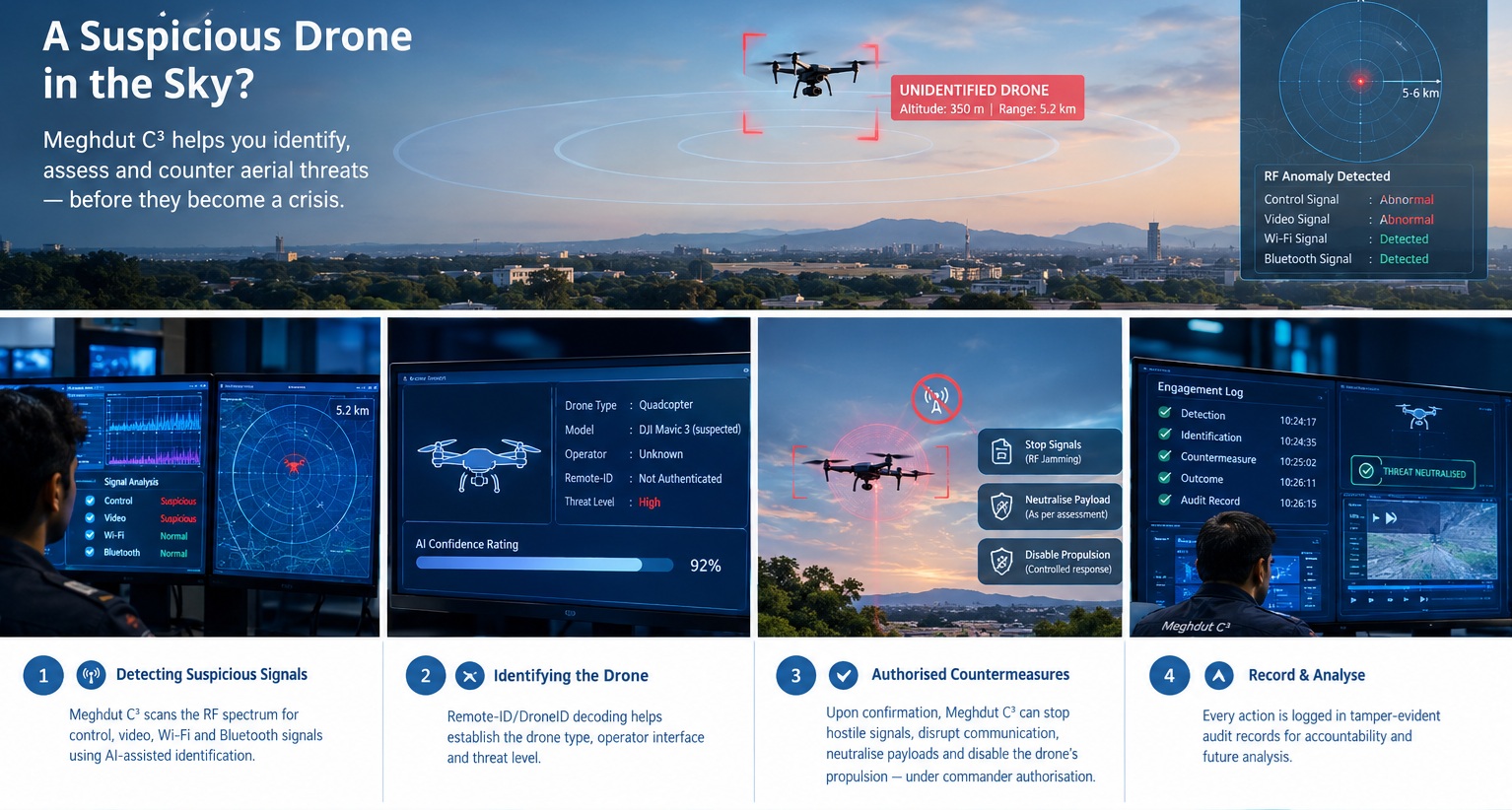
1. Detect suspicious signals
Meghdut C³ continuously scans the radio frequency (RF) spectrum for drone control and video links, along with Wi-Fi and Bluetooth signals. Artificial intelligence (AI)-assisted analysis gives each detection a confidence rating.
When a drone’s signals or communication patterns do not match expected behaviour, the platform flags it straight away. Security teams get an early warning they can investigate, instead of relying on someone happening to spot the drone.
2. Identify the drone and assess the risk
Detection is only the beginning. Meghdut C³ decodes Remote Identification (Remote ID) and DroneID broadcasts, the electronic identity that many drones transmit, to establish what the drone is. It then classifies the drone type, its operator interface and its threat level.
This step matters because an unidentified drone is not automatically a hostile one. Survey flights, media coverage and authorised operations all share the sky. Identification is what separates a genuine threat from legitimate activity.
3. Authorise the response
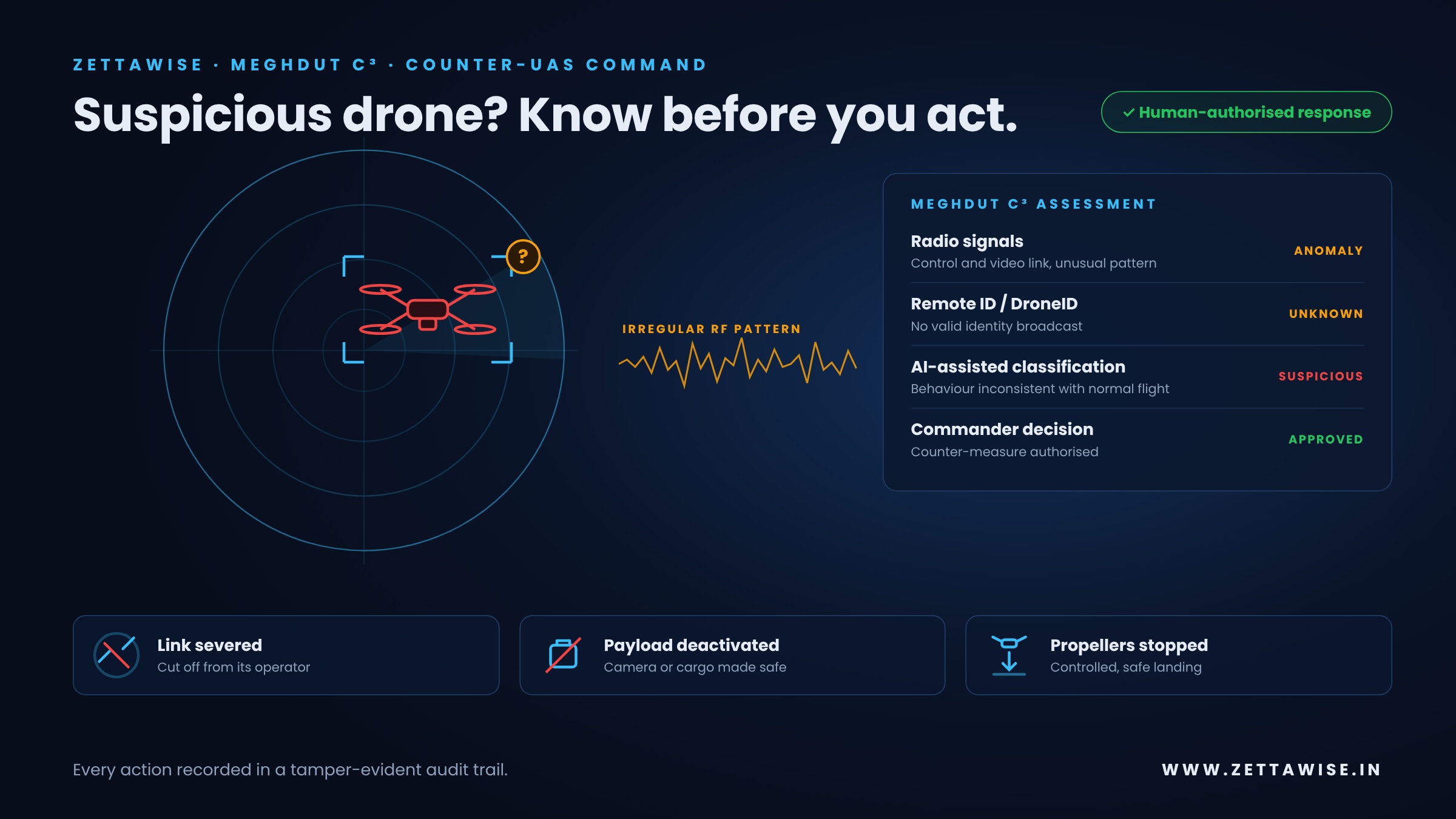
If the assessment shows the drone may be conducting surveillance or could pose a physical threat, the next step is a decision, and that decision stays with people. Meghdut C³ requires commander authorisation and runs Identification Friend or Foe (IFF) checks before any counter-measure is used. Nothing is engaged automatically.
4. Counter the threat
Once a response is authorised, Meghdut C³ can stop the drone in three ways:
- Cut the signal: it stops the suspicious transmissions and severs the drone’s connection to its unauthorised ground station or remote operator.
- Neutralise the payload: it deactivates the drone’s onboard payload, including a hazardous one, so it cannot be used or triggered.
- Stop the propellers: through targeted counter-measures such as RF jamming or takeover of compatible drones, it halts the propellers and forces a controlled, fail-safe landing.
These counter-measure capabilities are currently in live validation, and their use is always subject to authorisation by the competent authorities.
5. Record the incident
Every action is written to a tamper-evident audit record. Security teams can review exactly what happened and when, support any investigation, and improve their response procedures for next time.
Why This Approach Matters
- It tells friend from foe: identification comes before action, so legitimate flights are not treated as threats.
- It acts before escalation: signal-level detection gives warning before a drone reaches its target.
- It keeps people in command: every counter-measure needs authorisation from a commander.
- It keeps data at home: the platform is sovereign and air-gapped, with no cloud or internet dependency.
- It leaves a clear record: tamper-evident logs support accountability and review.
Secure The Skies with Meghdut C³
Unauthorised drone activity is a growing security challenge, and visual surveillance alone is no longer enough. Organisations need a structured way to detect suspicious signals, identify potential threats and respond through authorised counter-measures. Meghdut C³ brings these capabilities together in one indigenous, sovereign and air-gapped Counter-UAS command platform.
Don’t wait for a suspicious drone to become a serious security incident. Talk to Zettawise Consulting about how Meghdut C³ can strengthen your counter-drone preparedness and aerial threat response.
Explore Zettawise’s Aerial Resilience capabilities at Securing Unmanned Aerial Systems with Precision and Purpose