
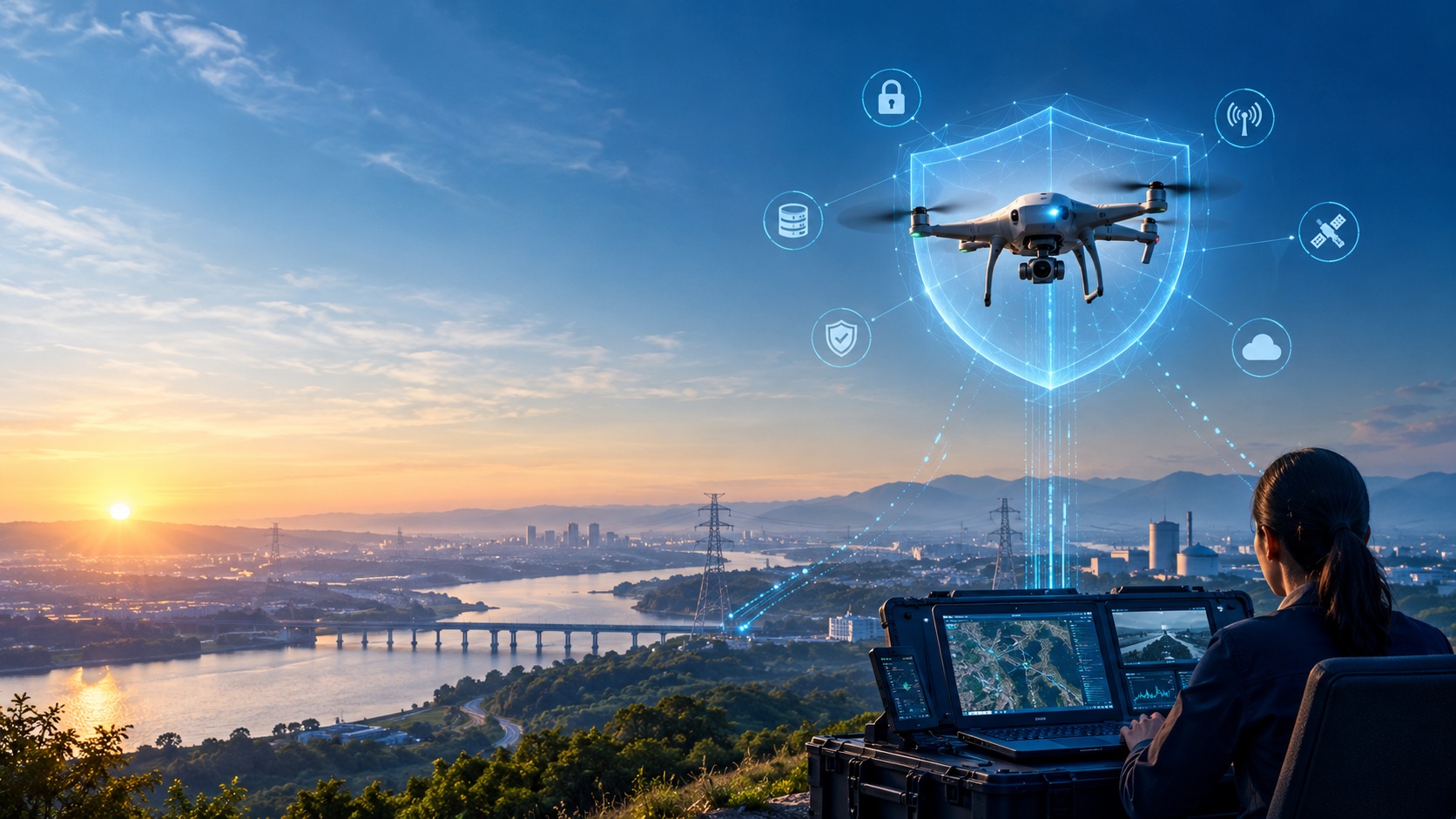
Beyond Flight Performance: The Need for UAV Security Assurance
As India expands its indigenous drone and unmanned aerial vehicle (UAV) capabilities, attention is increasingly extending beyond flight performance, payload capacity and autonomous navigation. A critical question deserves equal consideration: can these aerial systems be trusted to protect their communications, mission data and operational integrity against evolving cyber and physical threats?
Modern drones are interconnected cyber-physical systems. They collect sensitive imagery, process sensor information, exchange telemetry, receive control commands and interact with ground control stations and, in some deployments, cloud-based platforms.
A vulnerability in any of these components could compromise mission data, disrupt communications or affect the reliability of operations. Security assurance must therefore be an integral part of UAV development, deployment and maintenance—not an afterthought.
1. Why Indigenous Drone Security Assurance Matters
Indigenous UAVs have applications across defence, public safety, infrastructure inspection, agriculture, logistics, energy and smart-city operations. As their adoption expands, the security of the complete UAV ecosystem becomes increasingly important.
Indigenous Drone Security Assurance is a structured approach to identifying vulnerabilities, evaluating security controls and assessing how effectively a UAV platform withstands disruption.
The assessment should consider the aircraft, onboard software, communication links, sensors, payloads, ground control systems and supporting digital infrastructure.
Key areas include:
- UAS threat modelling and risk assessment: Identifying assets, attack surfaces, threat scenarios and potential mission impacts.
- Command-and-control and telemetry security: Assessing authentication, message integrity, communication protection and loss-of-link behaviour.
- Payload and mission-data protection: Evaluating the confidentiality, integrity and accessibility of imagery, sensor readings and collected information.
- Firmware and software security: Reviewing update mechanisms, software integrity, access controls and relevant configuration weaknesses.
- Ground control station security: Assessing operator access, endpoint protection, system configuration and supporting network security.
- Supply-chain security: Examining third-party components, libraries, firmware and external dependencies.
Indigenous development is an important consideration for technology ownership and operational autonomy, but it does not automatically guarantee cybersecurity. Assurance must be based on systematic testing and evidence.
2. Securing the Communication and Telemetry Layer
Telemetry allows a UAV and its supporting systems to exchange operational information. Depending on the platform, this may include position, altitude, speed, battery status, sensor readings and system-health information.
Security weaknesses in communication and control mechanisms may expose systems to unauthorised commands, data manipulation, replay attacks or communication disruption.
A structured security assessment can examine authentication, cryptographic protection where applicable, key management, message integrity, replay resistance and the system's response to communication loss.
The objective is to establish whether communication mechanisms behave as intended and whether the platform responds safely to defined failure and threat scenarios.
.jpg)
3. Protecting Payloads, Sensors and Mission Data
The security of a drone extends beyond the aircraft's ability to fly. Cameras, thermal sensors, mapping equipment and other payloads may collect sensitive operational or infrastructure information.
Security assurance should examine how this information is collected, processed, stored, transmitted and accessed.
Relevant assessment areas include:
- Unauthorised access to payload data.
- Integrity of sensor-generated information.
- Protection of stored and transmitted mission data.
- Access control and data-handling practices.
- Security of interfaces connecting payloads to onboard systems.
Protecting mission data helps organisations maintain confidence in the information used for operational decisions.
4. Testing Resilience Beyond Normal Operating Conditions
Identifying vulnerabilities is only one part of security assurance. Organisations must also understand how a UAV behaves when components fail, communications are interrupted or security controls encounter abnormal conditions.
Security testing identifies weaknesses; resilience testing evaluates how the system responds, recovers and maintains safe behaviour under defined adverse conditions.
Depending on the platform and its operational requirements, controlled testing and simulation may examine:
- Communication interruption and recovery.
- Loss-of-link procedures and predefined failsafe behaviour.
- Fault tolerance and recovery mechanisms.
- System behaviour under degraded operating conditions.
- Integrity of control and monitoring functions.
- Recovery following a security incident.
All testing should be authorised, risk-assessed and conducted in a controlled environment, with appropriate safeguards for personnel, equipment and airspace.
5. From Incident to Evidence: UAV Digital Forensics
When a UAV experiences suspicious behaviour, unexpected communication loss or a suspected compromise, understanding the incident is essential.
UAV digital forensics can help establish a timeline of events, identify potential causes and support remediation.
Depending on the platform and available evidence, an investigation may examine flight logs, telemetry records, onboard system logs, configuration changes, communication metadata and relevant ground control station records.
Evidence preservation, integrity verification and documented analysis are important to maintaining the reliability of findings.
The results can inform root-cause analysis, corrective actions, security improvements and future resilience testing.
6. Building Security into the UAV Lifecycle
Security assurance is most effective when it continues throughout the platform lifecycle rather than being treated as a one-time exercise.
01 Assess
Identify assets, threats, attack surfaces and risks.
02 Test
Evaluate security controls and validate identified weaknesses.
03 Harden
Implement corrective measures and strengthen configurations.
04 Validate resilience
Test recovery, failsafe behaviour and operational response.
05 Investigate and improve
Analyse incidents, preserve evidence and update security controls.
This lifecycle approach helps organisations move from reactive vulnerability remediation towards proactive, evidence-based security engineering.
Applicable standards and frameworks should be selected according to the UAV's architecture, intended use, risk profile and regulatory obligations. Where relevant, organisations can align their assessment methodology with established cybersecurity risk-management, software security and system-assurance practices.
7. Strengthening Indigenous UAV Security with Zettawise Consulting
Zettawise Consulting's Indigenous Drone Security Assurance service concept focuses on assessing and strengthening the security and resilience of domestically developed UAV platforms.
Its proposed Aerial Resilience capabilities encompass:
- UAS threat modelling and risk assessment.
- Telemetry and payload integrity validation.
- UAV security testing and hardening.
- Resilience testing and simulation.
- Post-incident digital forensics.
- Regulatory and security-framework alignment.
The scope of each engagement can be tailored to the platform architecture, intended mission, operational environment and assurance requirements.
By bringing vulnerability assessment, resilience validation and lifecycle security together, organisations can develop a clearer understanding of their UAV security posture and prioritise corrective actions based on risk.
The objective is to support trustworthy aerial systems through security by design, evidence-based assurance and continuous improvement.
Trust Must be Engineered
The future of indigenous UAV technology will depend not only on how effectively drones fly, navigate and perform their missions, but also on how reliably they protect data, communications and control systems.
Security assurance provides a structured way to identify weaknesses, validate safeguards and evaluate resilience before and during operational deployment.
A trustworthy UAV is not simply one that can fly safely. It is one whose software, communications, data, control mechanisms and operational behaviour have been assessed against defined security requirements.
For organisations developing and deploying indigenous drones, building security into the UAV lifecycle is an important step towards dependable and resilient aerial operations.
Publication note: Describe the listed capabilities as available services only after Zettawise has confirmed the scope it can deliver. Any claims of certification, regulatory approval or demonstrated testing results should be supported by evidence.