
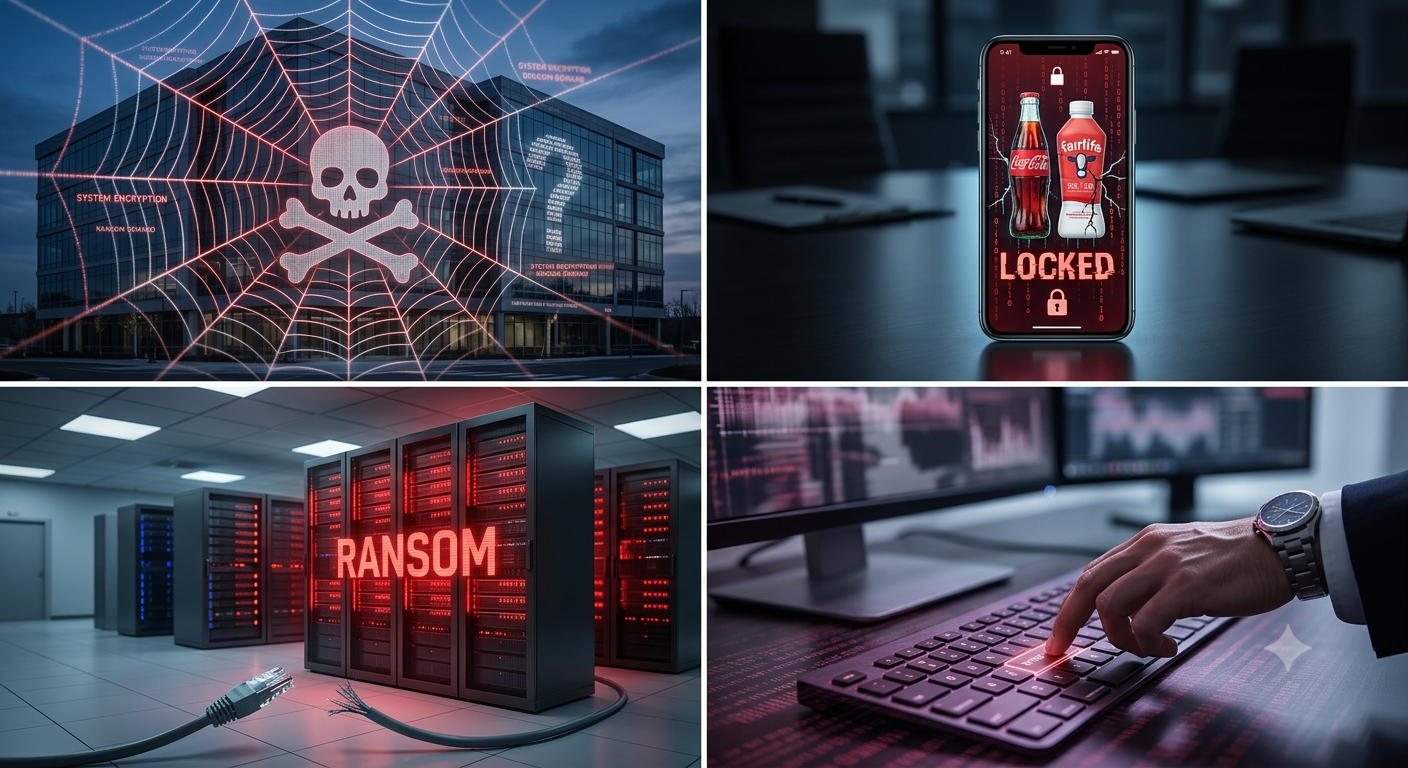
On 16 July 2026, The Coca-Cola Company disclosed in a Form 8-K filing with the U.S. Securities and Exchange Commission (SEC) that its high-protein dairy subsidiary, Fairlife, had experienced a ransomware attack affecting parts of its IT infrastructure. While the filing was measured in tone, the operational impact was significant—milk production at Fairlife's facilities across the United States was temporarily suspended as the company responded to the cyber incident.
The attack targeted far more than a regional dairy business. Fairlife has grown into a $4 billion brand within Coca-Cola's global portfolio and had recently announced a $650 million expansion of its production facility in Coopersville, Michigan. Despite its scale, resources, and market position, the organisation was unable to avoid operational disruption caused by a sophisticated ransomware attack.
The incident serves as a powerful reminder that no organisation is beyond the reach of modern cybercriminals. Today's ransomware attacks are designed not only to encrypt data but also to interrupt business operations, disrupt supply chains, and maximise financial and reputational damage.
For businesses across every industry, the attack reinforces the importance of proactive cybersecurity measures, robust incident response planning, and continuous monitoring. The lessons from Fairlife extend well beyond the food and beverage sector—they offer valuable insights into how organisations can strengthen cyber resilience before facing a similar attack.
The Coca-Cola Ransomware Incident Explained: What Really Happened Behind the Headlines
The attack on Coca-Cola's Fairlife subsidiary evolved quickly, illustrating the structured methodology employed by today's ransomware operators. Every stage of the incident reflected tactics commonly observed in modern cyber extortion campaigns, where operational disruption and data theft go hand in hand.
A Rapid Escalation
The sequence of events highlights how little time organisations have to respond once attackers gain access.
16 July 2026: Coca-Cola disclosed the cyber incident through an SEC Form 8-K, confirming that unauthorised actors had compromised part of Fairlife's technology environment, including systems supporting production. Although product safety was unaffected, the company temporarily halted U.S. milk production while Canadian facilities remained operational.
Incident Response: In response, Coca-Cola activated its cyber incident response procedures, implemented business continuity measures, engaged external cybersecurity experts, and coordinated with law enforcement. The company also cautioned investors that the investigation remained ongoing and that the complete impact of the incident had yet to be established.
20 July 2026: The ransomware group known as Anubis published the names of Coca-Cola and Fairlife on its dark web leak platform, signalling an attempt to publicly pressure the organisation.
21–22 July 2026: Anubis claimed responsibility for the attack, alleging that it had encrypted Fairlife's Nutanix infrastructure and exfiltrated approximately 1 TB of confidential corporate data. The attackers further threatened to release the stolen information if ransom demands were not met within one week.
Key Cybersecurity Takeaways
This timeline reflects several defining characteristics of contemporary ransomware attacks:
- Business disruption is used to increase financial pressure.
- Sensitive data is stolen before encryption takes place.
- Dark web leak sites are used as public extortion tools.
- Victims often face strict deadlines to influence negotiation decisions.
What is Anubis?
The name Anubis may still be unfamiliar to many business leaders, but cybersecurity teams should take notice. Emerging in December 2024, Anubis operates as a Ransomware-as-a-Service (RaaS) group, a business model that allows multiple criminal affiliates to launch attacks using shared ransomware tools and infrastructure. Security researchers have also linked the operation to a rebranding of the earlier Spinx ransomware, suggesting an evolution rather than the arrival of an entirely new threat actor.
If a Global Giant Can Be Hacked, What's Stopping Attackers from Targeting Your Business?
It is easy to assume that ransomware attacks of this scale only threaten multinational corporations. However, the Fairlife incident demonstrates that cybercriminals are not selective based on an organisation's size—they target businesses whose operations they can disrupt. Whether you are a global manufacturer or a regional enterprise, the underlying lessons remain the same.
Key Takeaways for Every Organisation
1. Operational Disruption Is the New Target
Modern ransomware attacks are no longer limited to stealing confidential data. Increasingly, attackers aim to disrupt business operations by targeting Operational Technology (OT) and production systems.
2. Crisis Communication Is Now Part of Cybersecurity
A cyber attack affects more than technology—it also tests an organisation's ability to communicate under pressure. Coca-Cola was required to notify regulators while simultaneously responding to customers, employees, investors, and the media, despite not yet knowing the full extent of the incident.
3. Backups Alone Will Not Stop Modern Ransomware
Traditional disaster recovery plans focused on restoring encrypted systems from backups. Today's ransomware groups employ double extortion, stealing sensitive information before encrypting systems and threatening to publish it if ransom demands are not met.
4. Preparation Determines the Outcome
No organisation can guarantee that it will never experience a cyber attack. What distinguishes resilient organisations is their level of preparedness.
Ultimately, organisations are judged not simply by whether they were attacked, but by how effectively they respond, recover, and continue operating.
Could Your Business Survive the Next Ransomware Attack? Here's How Zettawise Consulting Can Help
The Fairlife ransomware incident demonstrates that organisations are not judged solely on whether they experience a cyber attack, but on how effectively they prepare for, respond to, and recover from one. Cyber resilience begins long before an incident occurs. At Zettawise Consulting, we help organisations build the people, processes, and capabilities needed to withstand sophisticated cyber threats before they become business crises.
How Zettawise Consulting Helps Strengthen Your Cyber Resilience
Ransomware Readiness Assessment
Gain a clear understanding of your organisation's ability to defend against ransomware through a comprehensive assessment that evaluates your:
- Security controls and technologies
- Detection and monitoring capabilities
- Backup and recovery readiness
- Incident response maturity
- Business continuity preparedness
Cyber Crisis Tabletop Exercises
A cyber incident can place immense pressure on both technical teams and executive leadership. Our realistic, scenario-driven tabletop exercises enable organisations to:
A cyber incident can place immense pressure on both technical teams and executive leadership. Our realistic, scenario-driven tabletop exercises enable organisations to:
- Simulate ransomware attacks and operational disruption.
- Validate incident response procedures.
- Improve coordination between IT, OT, legal, communications, and leadership teams.
- Strengthen decision-making under real-world conditions.
Effective incident response depends on knowledgeable people. Our structured training programme equips employees and security teams with the skills to:
- Detect cyber incidents quickly.
- Execute established response procedures.
- Coordinate recovery activities.
- Minimise business impact during security events.
Cyber incidents rapidly become executive-level challenges. Board members must often make critical decisions regarding regulatory reporting, stakeholder communication, legal obligations, and business continuity while information is still emerging.
Our immersive programme prepares senior leadership through:
- Organisation-specific cyber crisis scenarios.
- Executive leadership workshops.
- Board-level tabletop simulations.
- Media response exercises.
- Regulatory and stakeholder communication simulations.