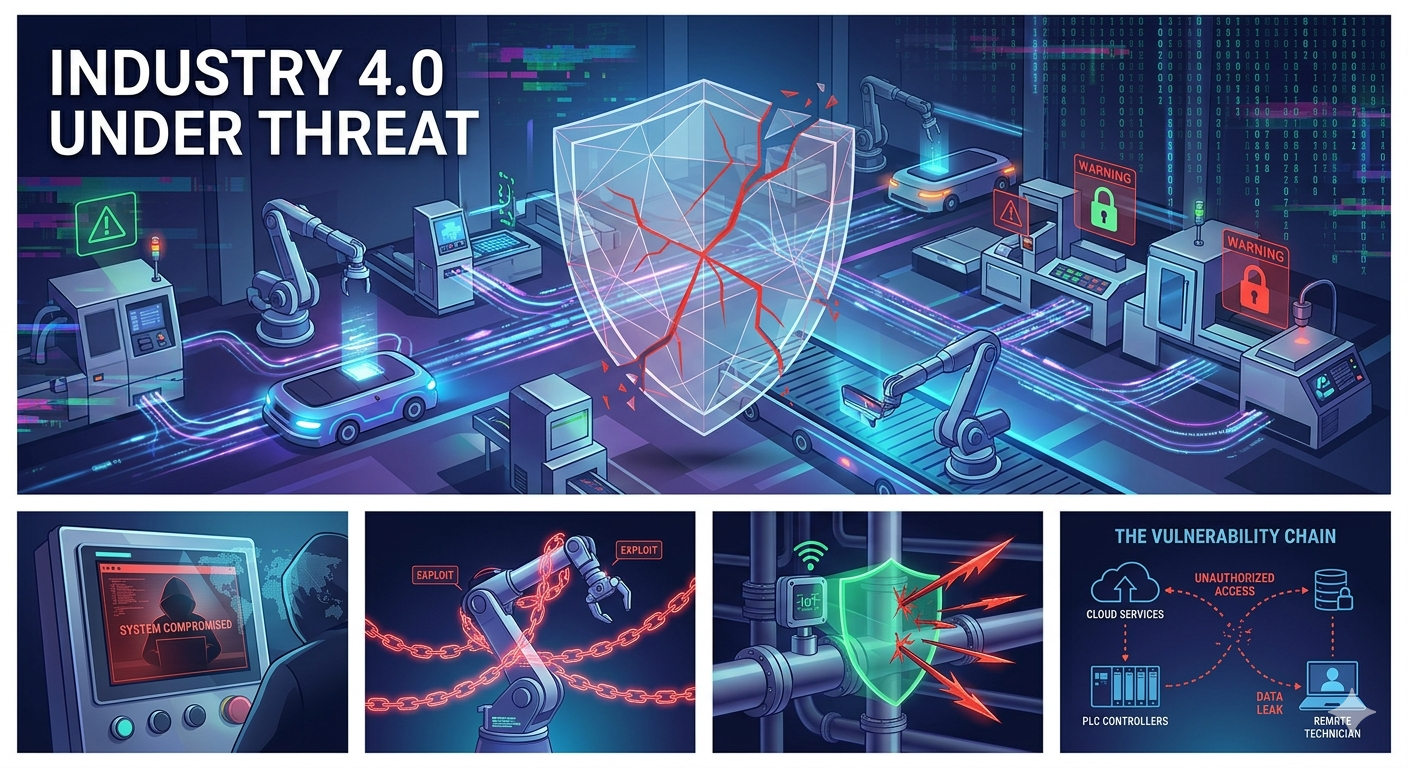
Industry 4.0 is revolutionising manufacturing by integrating IoT, AI, big data analytics and automated systems into everyday operations. These technologies enable smarter production, faster decision-making and greater efficiency, but they also create new opportunities for cyberattacks. As industrial networks become more interconnected, robust cybersecurity measures are essential to safeguard critical infrastructure. In this blog, we examine the major cybersecurity challenges affecting the manufacturing sector, with a particular focus on securing IIoT devices and Industry 4.0 environments.
What is Industry 4.0
The fourth industrial revolution, known as Industry 4.0, brings together cutting-edge technologies and secure data-driven operations to transform manufacturing. To fully benefit from these advancements, manufacturers must embrace innovation while adopting comprehensive cybersecurity measures that safeguard both digital infrastructure and physical operations from evolving cyber threats.
Manufacturing in the Era of Industry 4.0
Manufacturing is being transformed by the Fourth Industrial Revolution, enabling organisations of all sizes to achieve higher productivity and operational excellence. Technologies that were previously beyond the reach of small and medium-sized manufacturers have become more accessible, opening new opportunities for growth and competitiveness. At the same time, these digital advancements bring evolving cybersecurity challenges that require strong security measures and constant vigilance.
Key Technology-Driven Cybersecurity Threats in Manufacturing
The adoption of AI, Machine Learning, IoT, 5G and Robotics is revolutionising manufacturing, enabling smarter factories with improved efficiency, productivity and operational performance. While these innovations deliver significant business benefits, they also introduce new cybersecurity challenges by increasing the number of connected systems and potential points of attack.
1) AI and Machine Learning (ML): AI and Machine Learning play a vital role in modern manufacturing by streamlining operations, enabling predictive maintenance and improving product quality. These capabilities help manufacturers increase efficiency and productivity. At the same time, cybercriminals can exploit vulnerabilities in AI and ML systems by tampering with algorithms or training data, potentially causing production errors, operational disruption and financial losses.
2) Big Data Analytics: Big data analytics, when integrated with IoT technologies, empowers manufacturers with real-time data processing, informed decision-making and actionable business insights. While these capabilities enhance operational efficiency, the growing volume of sensitive data also increases cybersecurity risks. Protecting data integrity and ensuring secure data analytics have therefore become critical priorities for modern manufacturing environments.
3) IoT and IIoT Devices: IoT and IIoT technologies are at the heart of smart manufacturing, connecting machines, sensors and control systems to improve operational efficiency. While this interconnected ecosystem delivers substantial business benefits, it also creates a complex attack surface with numerous potential entry points for cybercriminals. Protecting connected devices and ensuring secure data transmission are therefore critical to maintaining a resilient manufacturing environment.
4) 5G Networks: 5G technology is revolutionising manufacturing by providing high-speed, low-latency communication that supports real-time data transfer and seamless connectivity across smart factories. Although it enhances operational efficiency and enables advanced industrial applications, it also expands the cyber risk landscape by introducing potential vulnerabilities that attackers may seek to exploit.
Key Cybersecurity Risks
Intellectual Property Theft: Cyber espionage poses a growing threat to manufacturers, as malicious actors seek to steal confidential designs, proprietary technologies and other intellectual property. Such breaches can undermine innovation, damage business competitiveness and erode customer trust. Implementing robust cybersecurity measures is critical to safeguarding intellectual property and preserving long-term business success.
Social Engineering and Phishing Attacks: Manufacturing organisations are increasingly vulnerable to social engineering attacks, especially phishing campaigns that exploit human error. As remote working becomes more common, employees may unknowingly respond to deceptive emails or messages, allowing cybercriminals to compromise sensitive systems, steal credentials and trigger costly security incidents.
Ransomware Attacks: Manufacturing organisations are prime targets for ransomware attacks, in which cybercriminals encrypt essential data and demand a ransom in exchange for decryption. Such attacks can result in severe financial consequences and disrupt business continuity, particularly when production systems and operational technology are compromised.
Lack of Basic Cybersecurity Practices: Many cyber incidents in manufacturing stem from inadequate implementation of basic cybersecurity controls. Adopting strong authentication mechanisms, maintaining robust network security and applying regular software and firmware updates are essential steps in reducing vulnerabilities and safeguarding manufacturing operations against evolving cyber threats.
The rapid adoption of Industry 4.0 technologies brings tremendous opportunities, but it also introduces increasingly complex cybersecurity challenges. Manufacturers must proactively address vulnerabilities associated with advanced technologies, ageing equipment and disconnected systems, while meeting regulatory requirements. Cybersecurity is no longer optional—it is a business imperative that safeguards operations, protects valuable data and builds the resilience needed to thrive in an increasingly connected manufacturing landscape.