
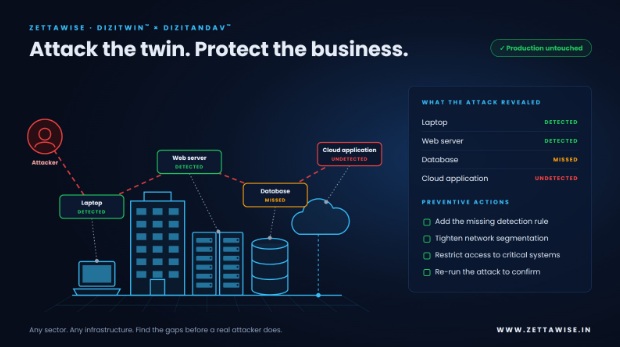
Zettawise's cyber-range appliance lets organisations replicate their environment, watch a live attack unfold, and fix the gaps before a real attacker finds them.
Every organisation hopes its defences will hold. Very few get to see them tested against a real attack without paying the price of one.
Picture this. An attacker gets into an engineering workstation, moves to a remote-access jump host, and reaches the systems that control a plant. Two steps raise alerts. One is missed. The final step goes completely unseen, and the attacker now controls a programmable logic controller (PLC) on the production floor. No alarm sounds.
In most organisations, this is discovered after the damage is done. With DiziTwin, it is discovered in a replica, where nothing real is at risk and every lesson can be turned into prevention.
Why Testing on The Real System Isn't An Option
Firewalls, intrusion detection, security monitoring, and network segmentation are now standard. But having these controls in place does not prove they will work together under pressure. Attacks don't hit one control at a time. They travel through the connections between systems, and that is where gaps hide.
The only way to find those gaps with confidence is to attack the environment. Attacking a live environment, especially operational technology (OT) that runs power plants, factories, and utilities, is far too risky. One wrong move can halt operations.
DiziTwin removes that dilemma. It gives organisations a working twin of their infrastructure to attack instead. Nothing here touches a production system.
.jpeg)
Step 1: Build A Twin of Your Environment
DiziTwin starts with the Architecture Creator, where teams recreate their own infrastructure inside the range. Using a palette of ready-made device templates, they drag in the components that make up their environment:
- Programmable logic controllers (PLCs) and remote terminal units (RTUs)
- Human-machine interfaces (HMIs) and intelligent electronic devices (IEDs)
- Plant historians, routers, and security monitoring systems
Each device is placed on its correct layer, from enterprise IT systems and the demilitarised zone that separates IT from OT, down through supervisory control and basic control to the field sensors on the plant floor. The result mirrors the way a real converged IT-OT plant is built.
With one click on Deploy, the design comes to life as running infrastructure: real systems, speaking real industrial protocols, inside an isolated range. In the demo, nine nodes go from design to running in seconds.
Step 2: Experience The Attack, Live
Once the twin is running, DiZITandav, Zettawise's attack engine, launches an attack against it.
Mission Control shows the attack path as it unfolds, step by step, from the attacker's entry point through each system it touches. At every step, the board shows exactly what happened:
- Detected: your defences caught it.
- Missed: the activity happened, but your defences failed to flag it.
- Undetected: the attacker reached the target and nothing saw it at all.
Alongside the attack path, a single board shows detection coverage, assets under attack, compromised systems, and open alerts. Everything is measured on the actual network traffic using Suricata sensors and the Wazuh security information and event management (SIEM) platform, so the results reflect what your monitoring tools really see, not what they are assumed to see.
For many teams, the first run is a wake-up call. Security that looked complete on paper turns out to have blind spots.
Step 3: Turn The Attack Into Prevention
This is where DiziTwin earns its value. Every step marked missed or undetected is a specific, evidence-backed gap, and each one becomes a preventive scenario the team can act on:
- Which detection rule needs to be written or tuned?
- Which network segment allows movement it shouldn't?
- Which device needs hardening, monitoring, or isolation?
Because the twin is safe to break, teams can make changes, run the attack again, and confirm the gap is closed. Over time, this builds a library of tested scenarios: a clear record of what was found, what was fixed, and what now works. It also gives security teams hands-on practice responding to attacks, so a real incident is never their first.
Built for Serious Industrial Environments
DiziTwin is designed for environments where security cannot be compromised:
- Nine OT protocols simulated: Modbus/TCP, DNP3, IEC 61850, OPC-UA, IEC 104, S7comm, EtherNet/IP, BACnet/IP, and MQTT
- Isolated range per tenant: every zone runs on its own routed segment
- Zero-trust control plane: secured with mutual TLS, with keys sealed in OpenBao
- Sovereign, on-premises appliance: sensitive architecture data never leaves your organisation
From Hoping to Knowing
A firewall can be configured correctly, a network can look properly segmented, and an attacker can still walk through unseen. The difference between organisations that are breached and those that are prepared is often simple: one waited for the attack, and the other rehearsed it.
DiziTwin lets you build your environment, experience the attack, and fix what your defences miss, before an attacker finds it first.
To see DiziTwin in action, visit www.zettawise.in.