
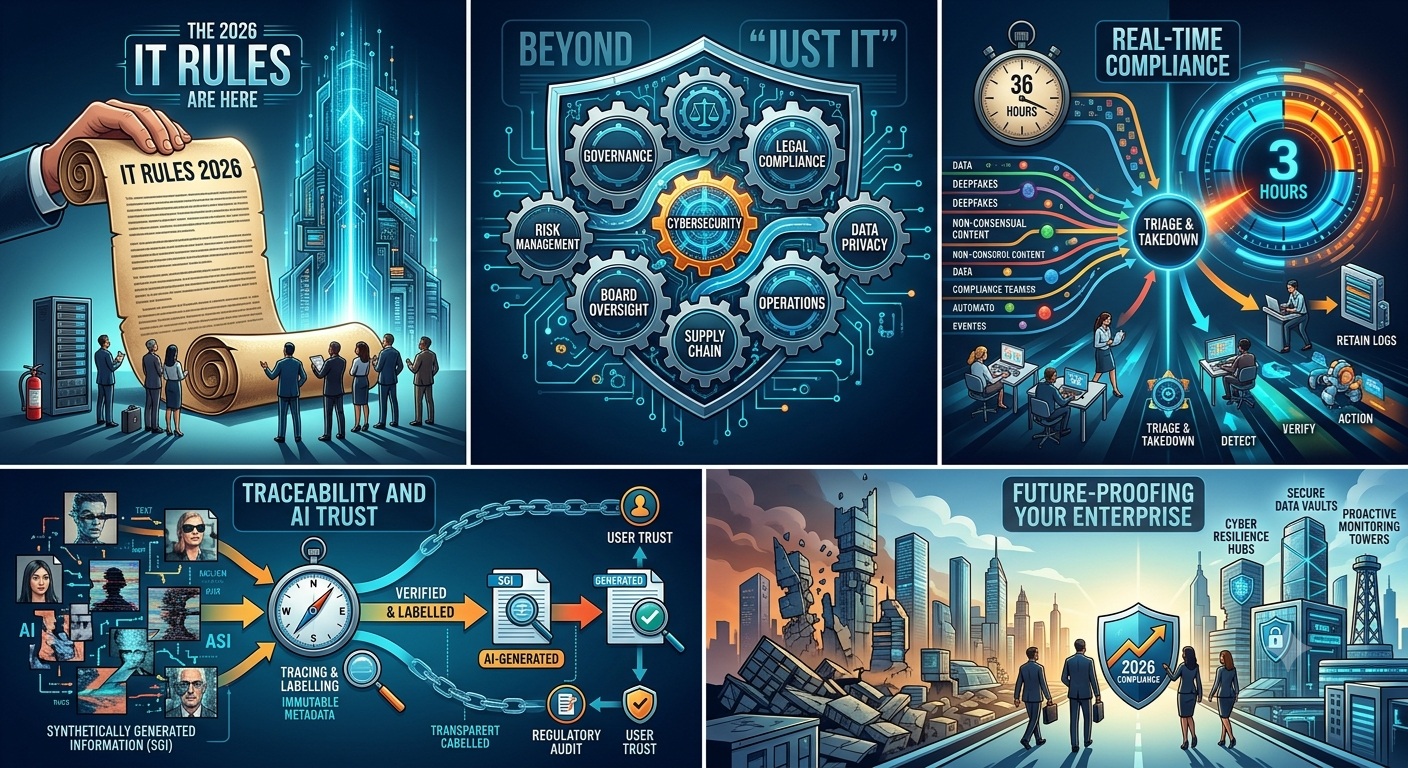
The 2026 amendments to India’s IT (Intermediary Guidelines and Digital Media Ethics Code) Rules have raised the bar for digital platforms by introducing an exceptionally short three-hour response window for certain unlawful or harmful content. Although the rules are primarily viewed through a legal and regulatory lens, they also create substantial cybersecurity and operational demands. CIOs and CISOs must now consider whether their monitoring, alerting, escalation, governance and response capabilities can support such time-sensitive compliance requirements.
A three-hour compliance deadline demands far more than traditional manual procedures can deliver. When security, legal, compliance, and operations teams work in isolation, critical decisions can be delayed. Organisations therefore need connected systems, automated workflows, real-time visibility, and clearly assigned responsibilities to respond to potentially harmful or unlawful content within the required timeframe.
Why Modern Compliance Requires More Than Legal Expertise
For years, organisations have managed regulatory obligations through a conventional division of responsibilities—legal teams defined what was required, operations put controls into practice, and security provided technical support. A three-hour response window challenges this model completely. Meeting such a demanding timeline requires legal, compliance, operations and cybersecurity teams to work together through connected processes, shared visibility and rapid escalation mechanisms.
The growing use of AI-generated and synthetically generated information (SGI) is creating a new intersection between regulatory compliance, content moderation and cybersecurity. Under the amended rules, digital platforms may face enhanced obligations concerning AI-generated content labelling, content provenance, verification mechanisms and faster removal of specified material. As a result, platforms must develop new operational capabilities that combine technology, security, compliance and content governance.
AI-Generated Content Is Creating a New Cybersecurity Challenge for Businesses
The growing sophistication of deepfakes and synthetic media has transformed them from a content-governance challenge into an emerging cybersecurity risk. Malicious actors can exploit AI-generated identities, voices and visuals to conduct impersonation attacks, manipulate employees, undermine authentication processes or enable financial fraud. This makes synthetic media detection, identity verification and security awareness increasingly important components of modern cyber defence strategies.
Tampering with AI content moderation or provenance controls can create risks that go far beyond cybersecurity. If adversaries manipulate detection systems, falsify content origins or disrupt traceability, digital platforms may be unable to fulfil their regulatory responsibilities. Consequently, what begins as a technical security breach can quickly escalate into a regulatory and compliance violation.
From Periodic Audits to Real-Time Compliance: The New Operating Model
India’s evolving IT Rules make one principle increasingly clear: compliance must become part of the product itself. Organisations can no longer depend solely on separate legal or operational teams to manage regulatory requirements after an issue occurs.
Platforms need built-in capabilities for detecting risks, escalating cases, initiating response workflows and maintaining complete audit trails. This also changes the role of cybersecurity teams. SOC operations must expand beyond servers, networks and endpoints to monitor content moderation, provenance and other digital trust systems.
Signals generated by content moderation should flow into SIEM and MDR platforms alongside conventional cybersecurity alerts. Given the speed and volume of modern digital operations, automation is no longer simply an optimisation—it is the foundation required for scalable compliance.
The Case for a Unified Security and Compliance Response Strategy
Modern digital incidents rarely fit neatly into a single compliance category. One security event can simultaneously create content, cybersecurity and data protection obligations, making coordination critical.
Consider an incident involving harmful content, a compromised account and exposed personal information. Depending on the applicable requirements, the organisation may need to:
- Respond to the content within a three-hour regulatory window.
- Fulfil relevant cyber incident reporting requirements.
- Assess and address personal data breach notification obligations.
The organisations that respond most effectively will treat cybersecurity and compliance as interconnected operational functions, rather than separate responsibilities. Unified workflows, automation and real-time visibility will become increasingly important.
Zettawise Consultancy Highlights 5 Critical Cybersecurity Priorities for CIOs and CISOs in 2026
As India’s digital and regulatory landscape evolves, CIOs and CISOs need to view cybersecurity as an integrated business and operational responsibility—not simply an infrastructure function. Based on Zettawise Consultancy’s experience across critical infrastructure, government, power, financial services, healthcare and manufacturing, organisations should prioritise five areas in 2026. Zettawise’s capabilities span IT/OT security assessments, VAPT, OT SOC, Cyber Range exercises, governance and risk advisory, and cybersecurity capability development.
Zettawise recommends that security leaders focus on:
- Integrating security and compliance response: Connect security monitoring, compliance workflows, escalation procedures and audit trails so teams can respond to incidents and regulatory requirements through a coordinated operating model.
- Strengthening identity and privileged access: Regularly assess administrative and high-privilege accounts, particularly across critical applications, moderation environments and operational systems.
- Protecting emerging technology and trust infrastructure: Treat AI systems, APIs, digital platforms, provenance mechanisms and other emerging technologies as security-critical assets requiring appropriate assessment and protection.
- Testing organisational readiness: Conduct VAPT, Red Team/Blue Team exercises, tabletop simulations and Cyber Range-based scenarios to evaluate how effectively teams can respond to complex, simultaneous cyber and compliance incidents. Zettawise specifically offers IT/OT VAPT and immersive Cyber Range exercises for this purpose.
- Making cybersecurity a board-level priority: Align cybersecurity investment with business continuity, regulatory readiness, critical infrastructure protection and measurable cyber resilience rather than treating security as a purely technical expense.
Zettawise’s experience with power-sector organisations, including IT/OT VAPT, ISMS implementation and cybersecurity capability development, demonstrates the importance of combining people, processes and technology in a risk-based security strategy.
Zettawise’s advice is clear: security leaders should build architectures and operating models capable of detecting, validating, escalating and responding to threats before regulatory or operational deadlines become critical.