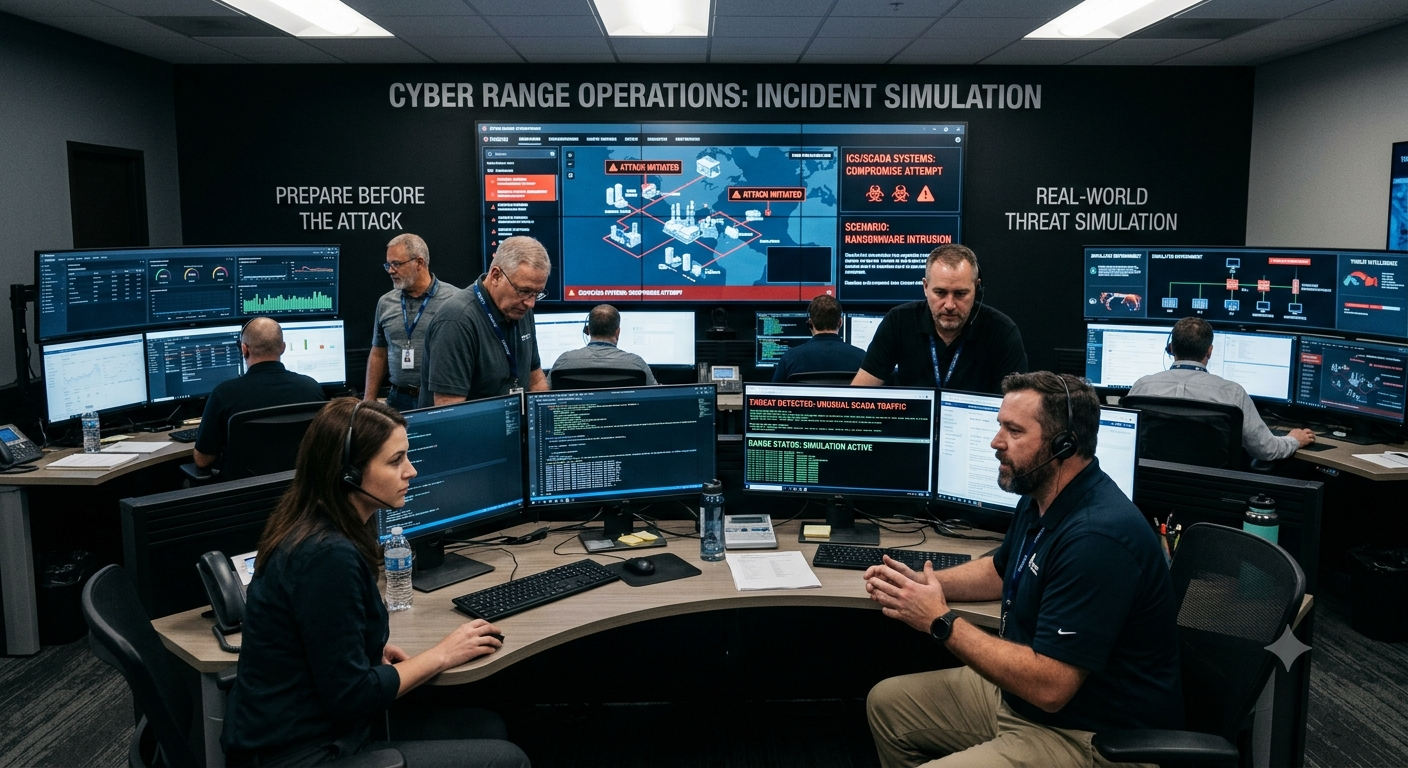
Critical infrastructure organisations—including those in energy, water, transportation, healthcare, manufacturing, and telecommunications—are increasingly targeted by sophisticated cyber threats. A successful attack on these sectors can disrupt essential services, cause financial losses, and even jeopardise public safety. While many organisations invest in cybersecurity tools, few truly know how their people, processes, and technologies will perform during a live cyber incident. This is where a Cyber Range becomes indispensable.
What is a Cyber Range?
A Cyber Range is a controlled environment that replicates an organisation's IT and Operational Technology (OT) infrastructure. It allows security teams to simulate real-world cyber attacks without affecting live business operations. By recreating networks, applications, industrial control systems, and user environments, organisations can safely evaluate their cyber defences under realistic conditions.
Unlike traditional training programmes, a Cyber Range offers hands-on experience against scenarios that mirror the evolving tactics used by modern threat actors.
Why Critical Infrastructure Cannot Rely on Theory Alone
Cybersecurity policies and compliance audits provide a solid foundation, but they do not reveal how an organisation will respond under pressure. Critical infrastructure operators often depend on interconnected systems that must remain operational around the clock. Even a minor security lapse can have significant operational and societal consequences.
Cyber Ranges bridge this gap by enabling organisations to:
Simulate ransomware and malware attacks.
Test incident response procedures.
Evaluate communication between technical and executive teams.
Validate disaster recovery and business continuity plans.
Assess the effectiveness of existing security controls.
These practical exercises help identify weaknesses before attackers exploit them.
Strengthening IT and OT Security
The convergence of IT and OT has expanded the cyber attack surface for critical infrastructure. Legacy industrial systems, remote access solutions, and interconnected devices introduce new vulnerabilities that cannot always be assessed through conventional penetration testing.
A Cyber Range allows organisations to safely simulate attacks on both IT and OT environments, helping engineers and security professionals understand how cyber incidents could affect operational processes. This enables them to refine detection mechanisms, improve response strategies, and minimise operational disruption.
Building Organisational Resilience
Technology alone cannot prevent every cyber attack. Equally important is ensuring that employees know how to respond when incidents occur.
Cyber Range exercises encourage collaboration between security analysts, IT administrators, OT engineers, management teams, and executive leadership. Regular simulations improve decision-making, clarify roles and responsibilities, and enhance confidence during real incidents.
This level of preparedness contributes directly to organisational resilience and reduces recovery time following an attack.
For critical infrastructure organisations, cyber resilience is no longer optional—it is essential. Waiting until a real attack occurs to discover weaknesses can result in costly downtime, regulatory consequences, and reputational damage.
A Cyber Range enables organisations to test their people, processes, and technologies in a realistic yet risk-free environment. By identifying vulnerabilities, validating response capabilities, and strengthening operational readiness, organisations can face evolving cyber threats with greater confidence. In today's threat landscape, practising for cyber attacks before they happen is one of the most valuable investments an organisation can make.