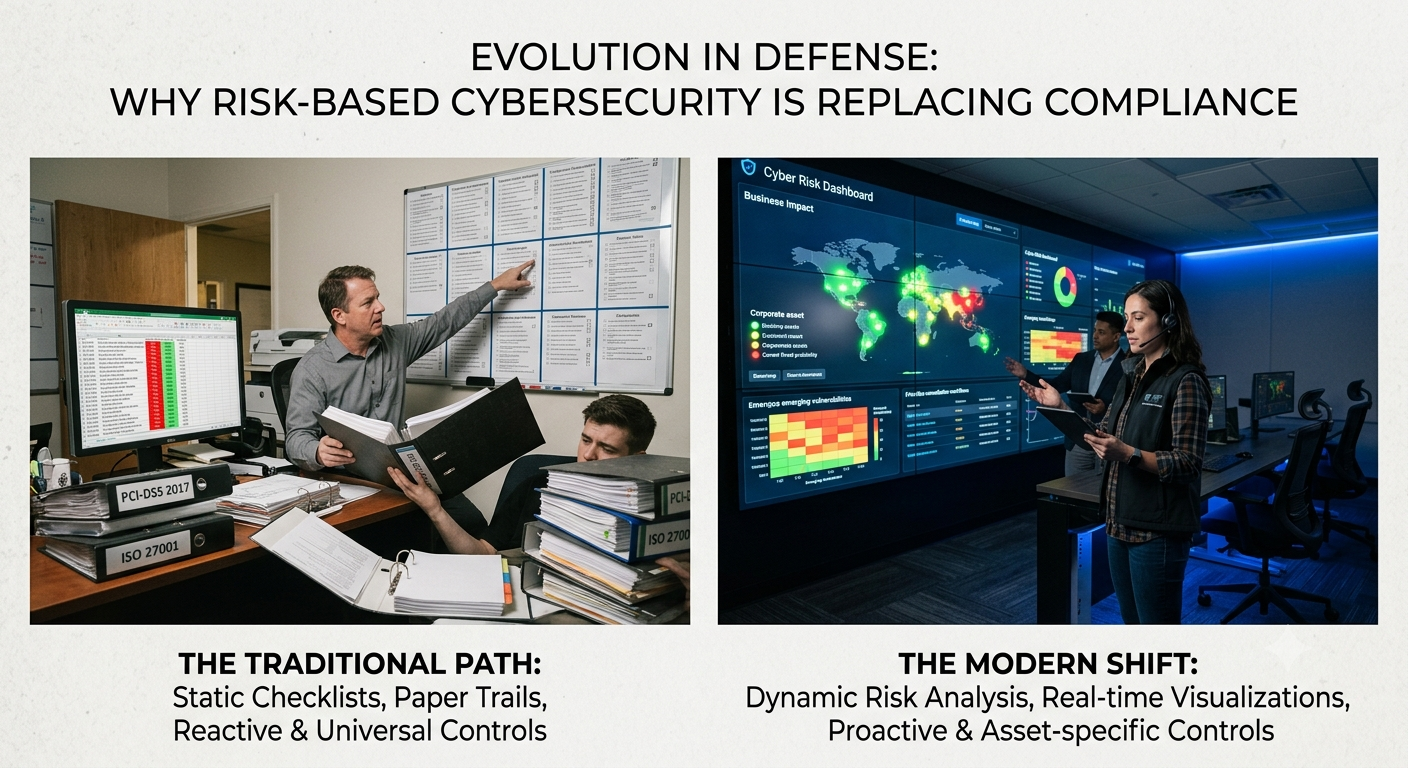
Organisations today face an increasingly sophisticated cyber threat landscape where simply meeting regulatory requirements is no longer enough. While compliance standards such as ISO 27001, PCI DSS, and GDPR establish important security baselines, they cannot guarantee protection against emerging threats. As cybercriminals continually evolve their tactics, businesses are shifting towards risk-based cybersecurity—a proactive approach that prioritises the protection of the assets and processes that matter most.
Compliance Alone Cannot Stop Modern Cyber Threats
Traditional compliance-driven security focuses on meeting predefined regulatory or industry standards. Although achieving compliance demonstrates a commitment to security, it often results in organisations treating cybersecurity as a checklist exercise. Once an audit is complete, many businesses assume they are adequately protected.
However, cyber attackers do not operate according to compliance frameworks. They exploit vulnerabilities wherever they exist, regardless of whether an organisation has passed its latest audit. Compliance validates that certain controls are in place, but it does not account for new attack techniques, zero-day vulnerabilities, or rapidly changing business risks.
What is Risk-Based Cybersecurity?
Risk-based cybersecurity prioritises security investments based on the likelihood and potential impact of cyber threats. Rather than applying identical controls across every system, organisations focus on protecting their most valuable assets, critical operations, and sensitive information.
A comprehensive risk-based strategy typically includes:
Identifying critical business assets and data.
Assessing current and emerging cyber threats.
Evaluating vulnerabilities across IT and operational technology environments.
Analysing the potential business impact of successful attacks.
Prioritising remediation based on overall business risk.
This enables organisations to allocate resources where they will have the greatest security impact.
Why Businesses are Making the Shift
Several factors are driving organisations towards a risk-based security model.
Firstly, cyber threats are evolving far faster than compliance regulations. New ransomware groups, supply chain attacks, and AI-powered phishing campaigns emerge regularly, requiring continuous assessment rather than periodic compliance reviews.
Secondly, organisations now operate across cloud platforms, remote work environments, and interconnected third-party ecosystems. This expanded attack surface introduces risks that traditional compliance frameworks may not fully address.
Finally, executive leadership increasingly expects cybersecurity investments to align with business objectives. Risk-based security provides measurable justification for security spending by demonstrating how investments reduce operational and financial risk.
The Benefits of a Risk-Based Approach
Adopting risk-based cybersecurity offers several long-term advantages:
Better protection for high-value business assets.
More efficient allocation of cybersecurity budgets.
Faster identification of critical vulnerabilities.
Improved resilience against evolving cyber threats.
Enhanced decision-making for executive leadership.
Stronger alignment between cybersecurity and business strategy.
Rather than implementing every available security control, organisations focus on mitigating the risks most likely to disrupt operations.
Compliance remains an essential component of cybersecurity, but it should be viewed as the foundation rather than the destination. Today's threat landscape demands continuous risk assessment, adaptive security strategies, and business-driven decision-making.
By adopting a risk-based cybersecurity approach, organisations move beyond regulatory checklists and develop a security programme capable of responding to real-world threats. The result is greater resilience, smarter investment decisions, and a stronger ability to protect critical business operations in an increasingly complex digital environment.